The international monetary system rests on one asset at a time: the thing the world agrees to hold, price against, and settle in. That asset has changed shape twice in a century, and it is changing again. Each shift followed one rule, and reading the rule forward points to what comes next.

The dollar’s third form
Atlas AI LabsAtlas AI Labs
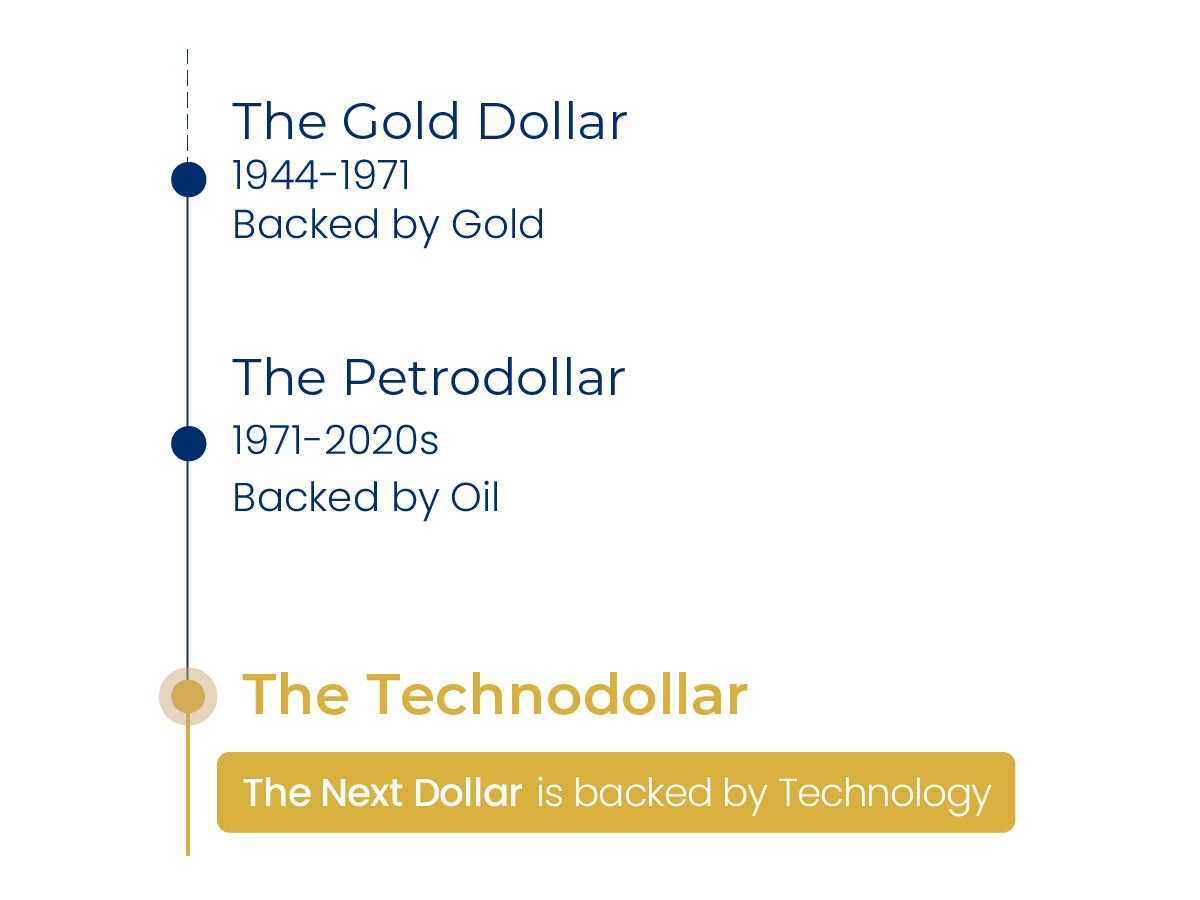
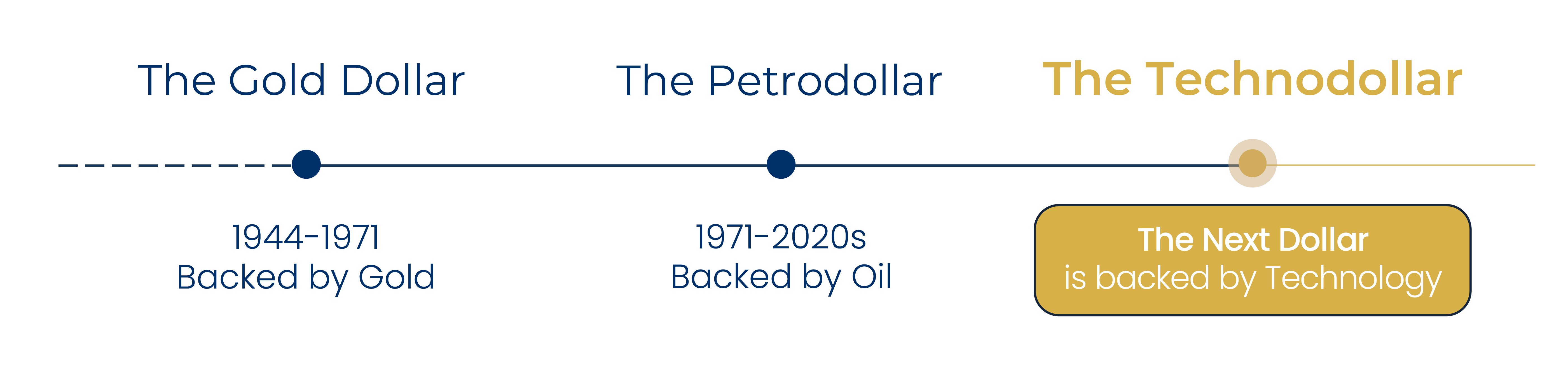
The first form was the gold dollar, its value anchored to something finite and physical. Bretton Woods fixed the dollar to gold and every other currency to the dollar, and the arrangement held while the link was cheaper to defend than to break. When defending it grew costlier than abandoning it, the United States let it go: Nixon closed the gold window in 1971. The petrodollar followed. Oil was priced in dollars, surplus revenue was recycled into U.S. Treasuries, and in exchange the United States supplied security and market access. The backing was no longer metal but the flow of the world’s most strategic commodity through American financial plumbing. That arrangement financed deficits, absorbed global production, and underwrote the postwar order for half a century. The third form is the technodollar, and its backing is neither metal nor oil. It is productive American technology: the compute, the models, the platforms, and the AI-enhanced enterprises now at the center of global output. Julius Baer’s currency strategists name it directly, describing a dollar “underwritten by digital infrastructure, platform power, and the global scramble for AI capacity.” The petrodollar is fading for structural reasons rather than geopolitical ones, and the dollar’s dominance is migrating to the source of backing that compounds hardest. Every transition obeyed the same logic: the backing asset is whatever the United States produces that the world cannot do without and cannot easily replace. In 1944 that was monetary credibility. In 1974 it was the security umbrella over energy. Today it is the AI stack and the productive capacity built on it, the backing of the dollar’s third form.

Three readings, one instrument

The word “technodollar” already circulates in public discourse, in three readings worth separating, because USAF occupies the space none of them fills. Macro strategists use it for a currency regime, an equity-allocation signal toward U.S. and Asian technology. Geopolitical analysts use it for statecraft: the United States granting controlled access to chips, cloud, and models on terms of alignment. A few private-credit ventures attach adjacent labels to instruments that lend against deep-tech equity. USAF is the instrument: the fund that holds the claim, with USAFi as its on-chain expression, the token a holder or an agent actually holds, settles, and verifies. Together they take the macro thesis and issue it as an asset. It is the technodollar in structured form: a regulated, actively managed claim on a basket of productive American assets. The thesis rests on three claims, each unfolding in a section below:

I. Allocation by intelligence

A reserve asset must hold its value across regimes no one can predict. The gold dollar managed that through scarcity, the petrodollar through the permanence of energy demand; the technodollar manages it through adaptation, reweighting itself as conditions change faster than any committee can. USAF is allocated by a quantitative model that reads the macro regime continuously, ranking the five sleeves spanning seven underlying asset classes against inflation prints, real rates, dollar strength, commodity term structure, and volatility surfaces, rather than by a quarterly investment meeting. The Investment Committee, chaired by Dr. Nouriel Roubini, sets the mandate, the constraints, and the bounds of acceptable risk, and approves every allocation; AI assists the research that keeps the model current. This adaptation matters most for a reserve asset, because rigidity is what broke every reserve form before it. Gold could not expand to meet a growing economy, so the link broke. The petrodollar could not adapt when shale turned the United States from oil importer to exporter. Allocation governed by continuous inference carries no such rigidity. It is built to move when the world moves.

II. Compounding inside the asset

The second claim concerns what the basket holds rather than how it is weighted. The productive American assets inside USAF are increasingly enterprises whose output AI amplifies. The defense and cybersecurity sleeve holds firms whose detection, targeting, and logistics now run on machine systems. The energy and commodity exposure tracks an economy rebuilding extraction, grid management, and demand forecasting around AI. The equity exposure reaches the productive core of an economy where, as Julius Baer notes, hyperscaler revenue is growing at its fastest pace in four years, off a base already half again as large as the last cycle’s. The companies that compound fastest are the ones AI makes more productive, and the basket is built to hold them. AI’s productivity gains accrue to this collateral rather than eroding it. A holder of USAF owns a claim on the part of the American economy that the defining technology of the era enhances rather than displaces. That distinction is why the technodollar can succeed the petrodollar rather than merely follow it. Oil was a claim on a finite, depleting input; AI-enhanced productive capacity is a claim on a compounding one. The backing asset grows with the thing that backs it.

III. The reserve asset for machines

Software agents have begun to transact and machine payment climbs as agentic systems move from assistants to actors. Between transactions, an agent needs somewhere to hold value: a default asset stable enough to hold without active management, liquid enough to settle instantly, and legible enough to verify without trusting a counterparty’s word. Stablecoins solve part of this. They settle on chain and hold a peg, but they do not earn, adapt, or carry a verifiable claim on productive assets. A stablecoin is a parked dollar; it preserves nominal value and nothing more. USAFi is built to be the asset an agent holds when a parked dollar is not enough. It settles on the same public rails a stablecoin uses, so an agent moves it just as easily. It carries a claim on the actively allocated, AI-enhanced basket, so it earns the return of the productive American economy instead of sitting flat. And its backing is published and inspectable on chain, so an autonomous system verifies solvency programmatically rather than relying on disclosure it cannot read.

Why this is the dollar’s next form

Reserve status has always followed the asset the world cannot do without. Gold gave way to oil because the security of energy mattered more to the postwar economy than the discipline of metal. Oil is giving way to AI-enhanced production because compute, models, and the enterprises built on them now matter more than the barrel. The technodollar is the recognition that the dollar’s backing has moved again, and USAF is the instrument that makes the recognition investable: a claim on productive American assets, allocated by intelligence, compounding under it, and built to be held by the intelligent systems that will increasingly transact on its behalf. The first reserve form was anchored to what was scarce, the second to what was strategic, the third to what is productive. In this era, productivity is what artificial intelligence multiplies. That is the technodollar. USAF is its first regulated form.